Inside the $600 billion AI infrastructure race shaping tomorrow’s data centers.
Cisco Systems recently made a major announcement that could shift the balance in the high stakes world of artificial intelligence infrastructure. On February 10, 2026, the company revealed its latest creation a next generation networking chip and router built to handle the exploding demands of AI-powered data centers. This move puts Cisco squarely in competition with some of the biggest names in the tech world, including Nvidia and Broadcom, as companies race to build the backbone of tomorrow’s AI systems.
What Is the Cisco Silicon One G300 Chip?
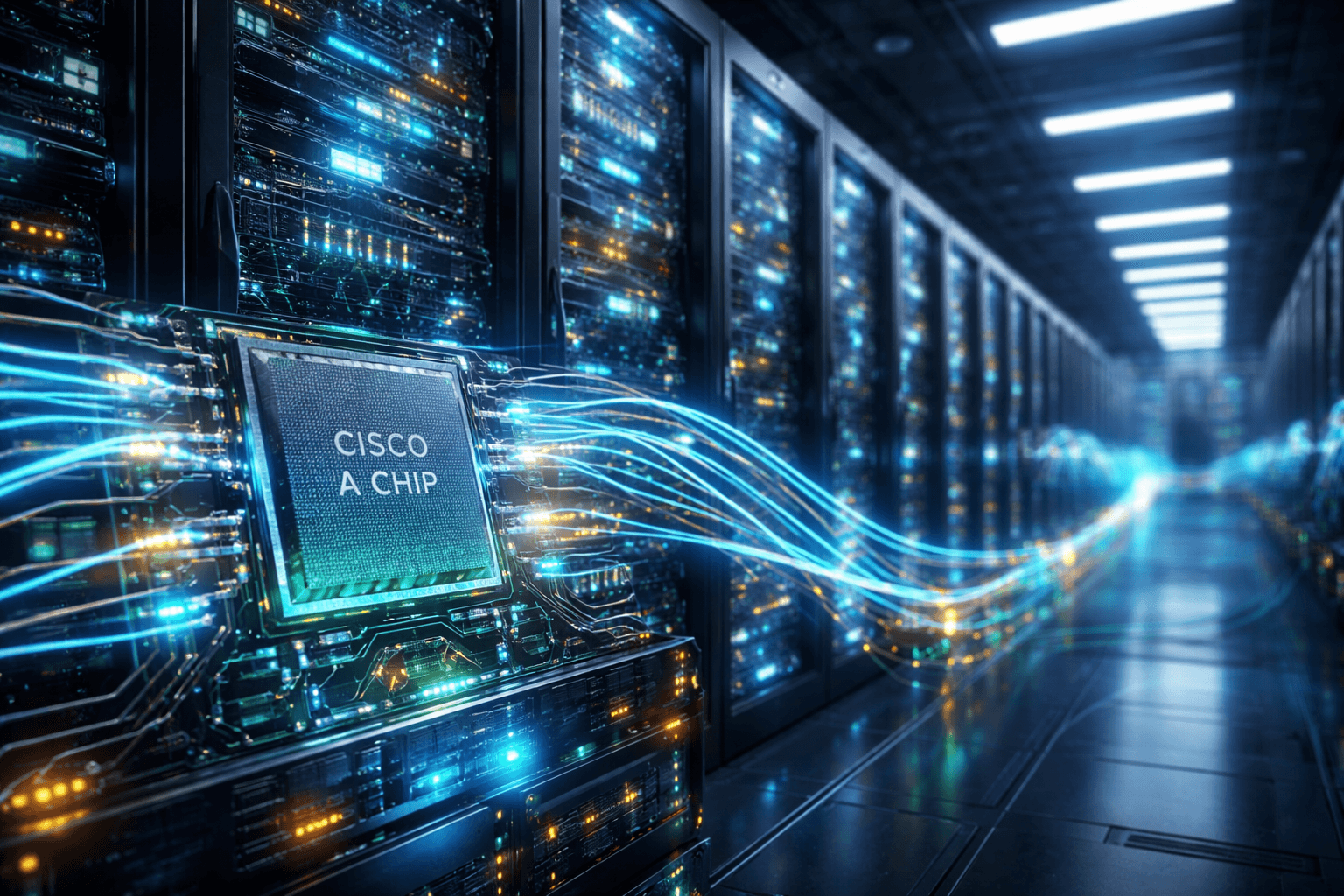
At the heart of Cisco’s announcement is a powerful new chip called the Silicon One G300. This chip is designed to improve how information moves through massive networks that support AI applications. Unlike traditional chips, the G300 focuses on networking efficiency ensuring that data flows smoothly and quickly between different parts of an AI system. Cisco says it will be available in the second half of 2026.
Why is this important? Modern AI systems, especially those used for large language models and advanced machine learning tasks, rely on huge interconnected data centers. Training and running these systems involves moving large volumes of data back and forth. Any delays or bottlenecks slow everything down. Cisco’s chip aims to significantly reduce those barriers by making the underlying network smarter and faster, reducing latency and helping data centers operate more efficiently.
A $600 Billion Market Opportunity
Cisco’s entry into AI networking chips is not just a technological milestone it’s also a strategic business move. The AI infrastructure market is expected to be worth hundreds of billions of dollars in the coming years. According to industry analysts, companies are investing heavily in hardware, software, networking, and cloud capacity to support AI workloads. By offering a product tailored to these needs, Cisco is aiming for a slice of this massive growth.
Beyond pure hardware, networking chips like the G300 play a central role in ensuring that data center operations can scale seamlessly. This includes handling surges in traffic and managing complex networking tasks without dropping performance a challenge that becomes more acute as AI systems grow in size and complexity. Cisco’s focus on smoothing data flows and preventing slowdowns could give it a competitive edge in a market traditionally dominated by other chip giants like Broadcom and Nvidia.


-640x427.png&w=3840&q=75)

-300x200.png&w=3840&q=75)
-300x200.png&w=3840&q=75)
-300x200.png&w=3840&q=75)

-1-300x200.png&w=3840&q=75)
-1-300x200.png&w=3840&q=75)
-300x200.png&w=3840&q=75)

-300x200.png&w=3840&q=75)
-300x200.png&w=3840&q=75)