AI Agents Can Talk, Use Tools, and Pay. Crypto Wants to Own the Escrow Layer
AI agents are moving fast toward a world where they can discover each other, coordinate tasks, access tools, and send money without a human sitting in the middle of every step. Google’s Agent2Agent protocol was built to help agents communicate across systems, while Anthropic’s Model Context Protocol was designed to connect models to tools and data sources. On the payments side, Coinbase’s x402 aims to let software and agents pay directly over HTTP with stablecoins.
That means the basic machine-commerce stack is starting to take shape.
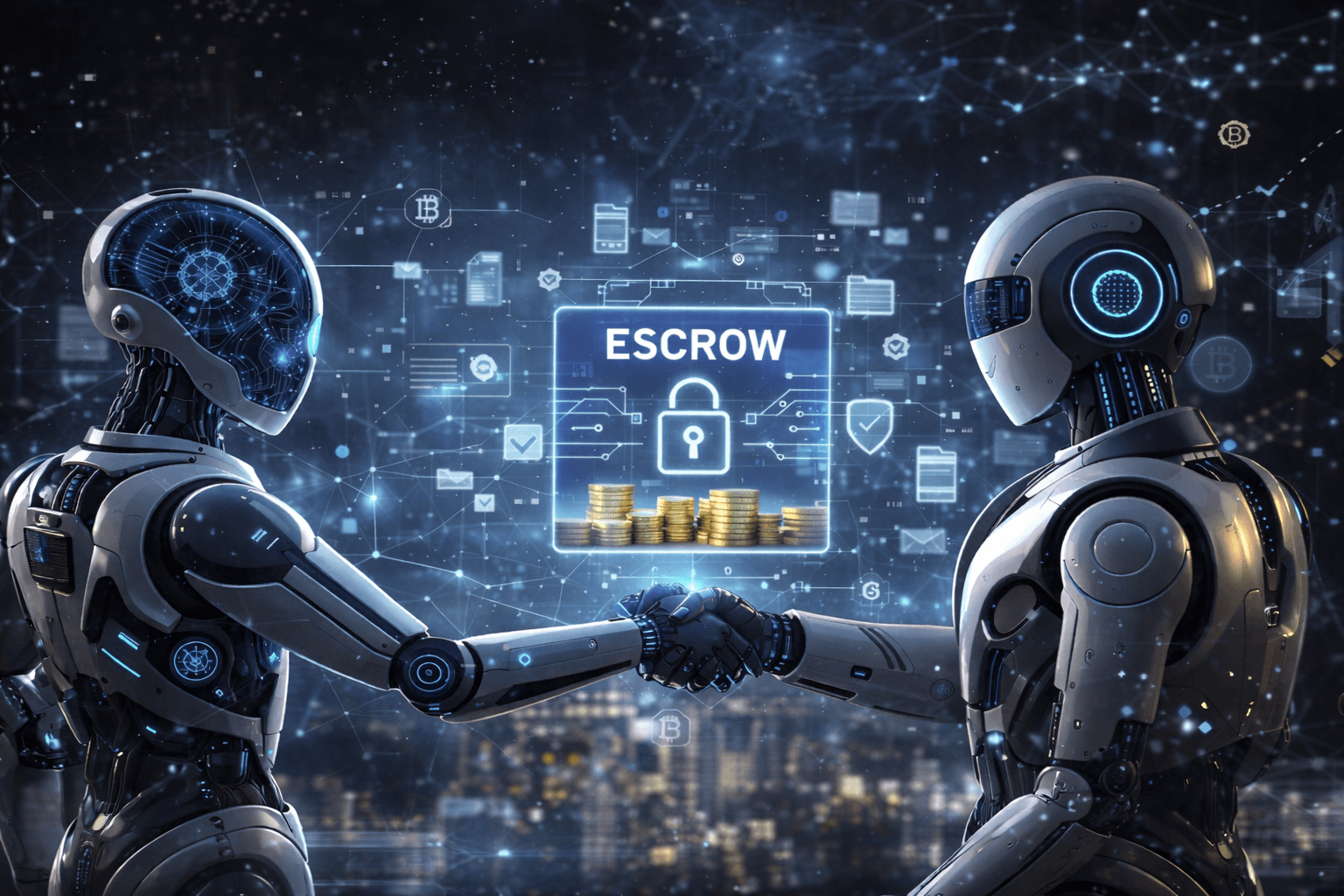
Agents can already talk. They can already reach tools. They are increasingly being built to pay. But as CryptoSlate argues, one critical gap remains: how do you safely handle the moment when one agent pays another for an outcome that has not happened yet?
That is the escrow moment.
And that is where crypto wants to plant its flag.
The stack is forming fast
The industry is no longer debating whether agents will become economic actors online. The conversation has already shifted to infrastructure.
Google introduced A2A as a protocol for secure communication and coordination between AI agents across platforms and enterprise systems. Anthropic introduced MCP as an open standard so models can connect to tools and external data in a structured way. Coinbase launched x402 to enable internet-native payments directly over HTTP, explicitly naming APIs, apps, and AI agents as target users.
That is a meaningful progression.
First, agents needed a way to exchange information. Then they needed a way to access capabilities. Now they need a way to move money. Framing is that the next logical step is not just payment, but conditional settlement: money gets locked, work gets done, an evaluator checks the result, and only then is payment released.
That is not a small technical tweak. It is the trust problem at the heart of agentic commerce.
Why simple payment is not enough
A payment rail solves only part of the problem.
If an AI agent pays another agent to retrieve data, generate a report, run a workflow, book a service, or complete some offchain task, the payment itself does not prove the result was actually delivered or delivered correctly. A stablecoin transfer can confirm that funds moved. It cannot, by itself, confirm that the job was done.
The real bottleneck is not whether an agent can send a tokenized payment. The bottleneck is whether autonomous systems can handle conditional trust at internet scale. That means dispute logic, holdbacks, refunds, verification, and outcome-based release. In other words, escrow.



-640x427.png&w=3840&q=75)

-300x200.png&w=3840&q=75)
-1-300x200.png&w=3840&q=75)

-1-300x200.png&w=3840&q=75)
-1-300x200.png&w=3840&q=75)
-300x200.png&w=3840&q=75)
-300x200.png&w=3840&q=75)
-300x200.png&w=3840&q=75)
-300x200.png&w=3840&q=75)