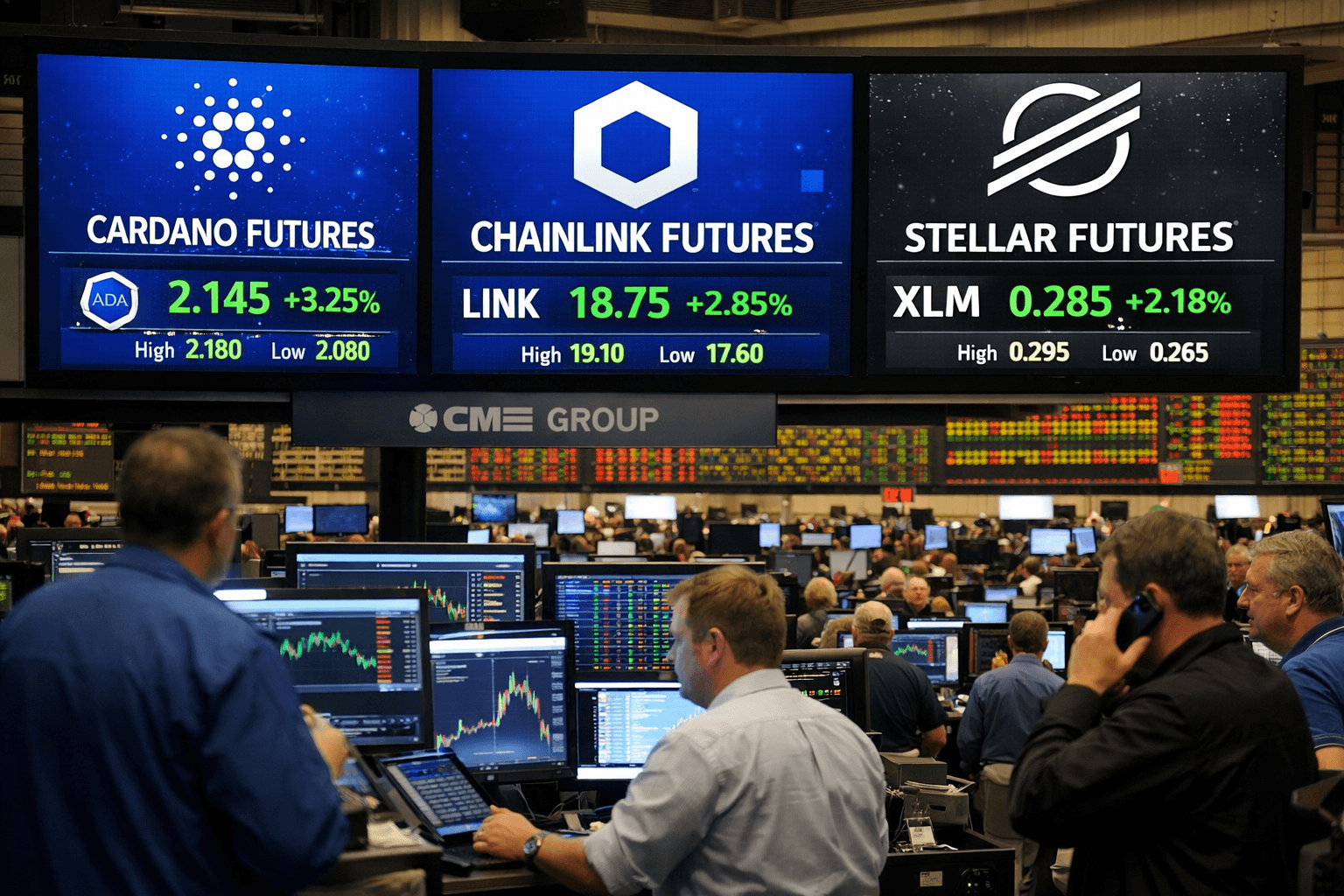
The cryptocurrency world is on the verge of a milestone event as the CME Group, the world’s dominant derivatives exchange,prepares to launch futures contracts tied to three major altcoins Cardano (ADA), Chainlink (LINK) and Stellar (XLM). This move signifies a growing shift in perception toward digital assets as not just speculative tokens but as investable instruments that can be traded, managed and hedged within regulated financial frameworks.
Scheduled to begin trading on February 9, 2026, pending regulatory approval from the United States Commodity Futures Trading Commission (CFTC), these new futures contracts are poised to further legitimize the role of cryptocurrencies in mainstream finance. While the announcement has generated excitement across institutional trading desks, it also raises important questions about market dynamics, investor access and the future integration of crypto markets with traditional finance.
A Milestone for Crypto Derivatives
For years, Bitcoin (BTC) and Ethereum (ETH) dominated institutional interest as the primary digital assets seen as mature enough for regulated products. CME’s expansion beyond these two giants into broader altcoin territory reflects the evolving landscape of crypto adoption. The addition of Cardano, Chainlink and Stellar to CME’s roster of futures signals that major altcoins are being recognized not only for their price action but for their underlying ecosystems and real world utility.
These futures contracts will be offered in standard and micro sizes, meaning that both larger institutional participants and smaller traders can engage with the market in ways that fit their strategies and risk tolerance. Standard contracts include large notional exposures — like 100,000 ADA or 5,000 LINK — while micro contracts bring the barrier to entry down significantly, such as 10,000 ADA or 250 LINK, making regulated trading more accessible.
The broader implications for the crypto market could be significant. Futures contracts enable participants to hedge risks, speculate on price movements and structure complex strategies without holding the underlying tokens in spot markets. In doing so, they help improve liquidity, market depth and the overall robustness of price discovery mechanisms. Moreover, the institutional embrace of these contracts might attract fresh capital, potentially smoothing volatility and fostering long term holding strategies among sophisticated investors.
What These Futures Mean for Cardano Chainlink and Stellar


-640x427.png&w=3840&q=75)
-3-640x427.png&w=3840&q=75)
-2-300x200.png&w=3840&q=75)