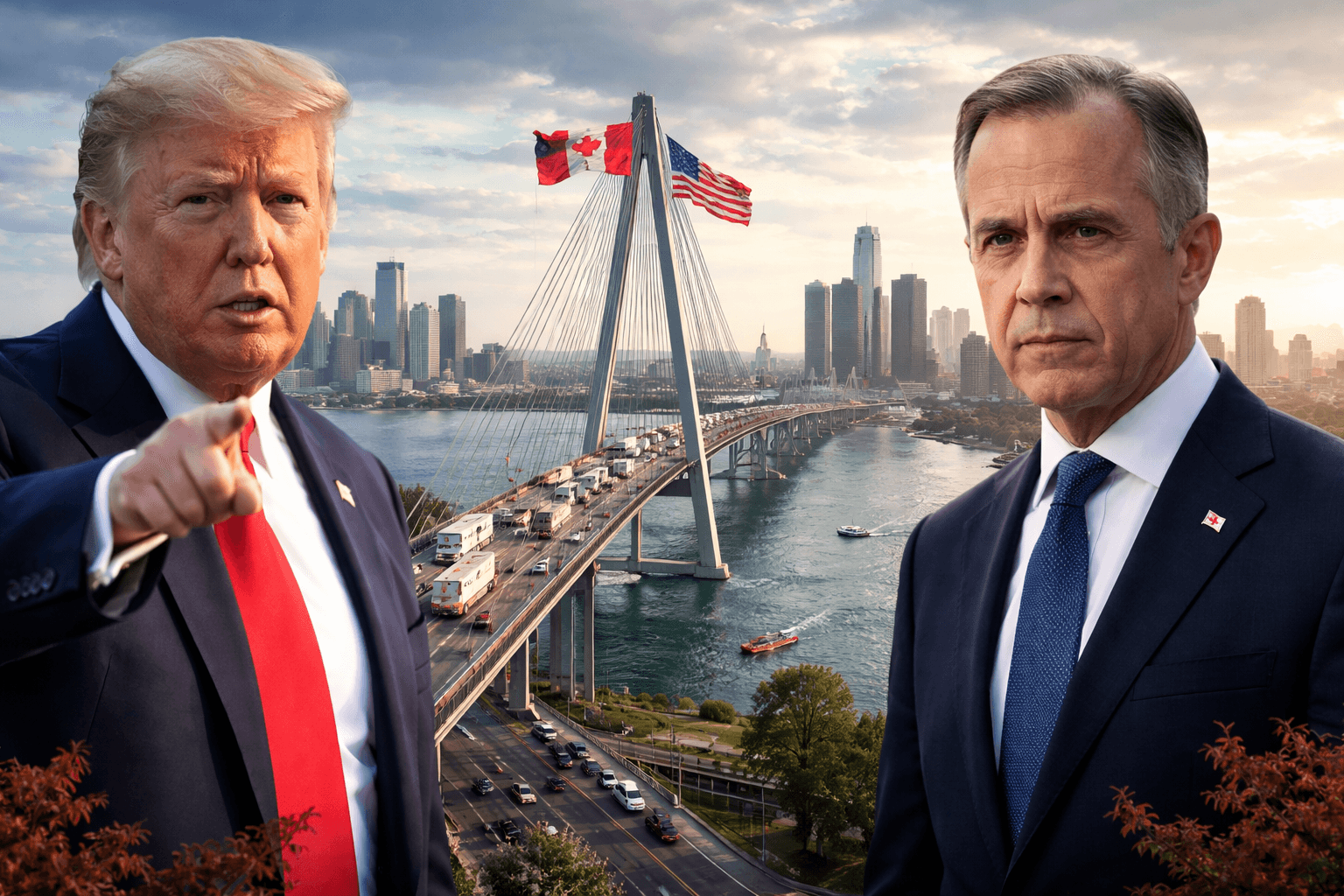
When geopolitics meets a bridge between nations
In early February 2026, a major piece of North American infrastructure the $4-7 billion Gordie Howe International Bridge linking Windsor, Ontario, and Detroit, Michigan suddenly found itself at the centre of a political storm between Canada and the United States. What began as a decades-long effort to improve trade connectivity has now become a flash point in a broader dispute over trade, tariffs, national pride and diplomatic relations.
What Is the Gordie Howe International Bridge?
The Gordie Howe International Bridge is an ambitious infrastructure project designed to link Canada and the United States physically and economically. The cable stayed bridge spans the Detroit River and will provide six lanes for vehicles, including a dedicated bike and pedestrian path a modern artery for people and goods crossing one of the busiest commercial borders in the world.
Financed entirely by the Canadian federal government, the bridge’s construction began in 2018 and has reached near completion, with an expected opening in early 2026. Ownership of the structure is shared between the Government of Canada and the State of Michigan, and toll revenue will be used to pay back construction costs over time.
For years, the project was hailed as a rare example of Canada U.S. cooperation, supported by leaders from both countries and viewed as a way to ease congestion at existing border crossings and strengthen the economic ecosystem that depends on cross-border trade.
A Surprising Ultimatum From Washington
In a move that caught many by surprise, U.S. President Donald Trump in office again after winning a second presidential term took to Truth Social in February 2026 to announce that he would not allow the Gordie Howe International Bridge to open unless Canada agreed to negotiate new terms that would “fully compensate” the United States. Trump’s post also argued that the bridge was built with “virtually no U.S. content” and suggested that the U.S. should own at least half of the bridge.
The dramatic nature of this ultimatum threatening to stall the opening of a project that had already taken years, billions of dollars and thousands of worker hours sparked immediate responses from political leaders, business groups and the public on both sides of the border.
How Canada Responded
Canadian leaders were quick to push back on Trump’s statements. Prime Minister Mark Carney held a phone conversation with the U.S. president shortly after the announcement, describing the call as “positive” and emphasising that Canada had fully funded the bridge and that U.S. steel and workers were involved in its construction. Carney underscored that the bridge’s ownership is shared and that the project represented cooperation, not unilateral advantage.


-640x427.png&w=3840&q=75)

-300x200.png&w=3840&q=75)
-300x200.png&w=3840&q=75)