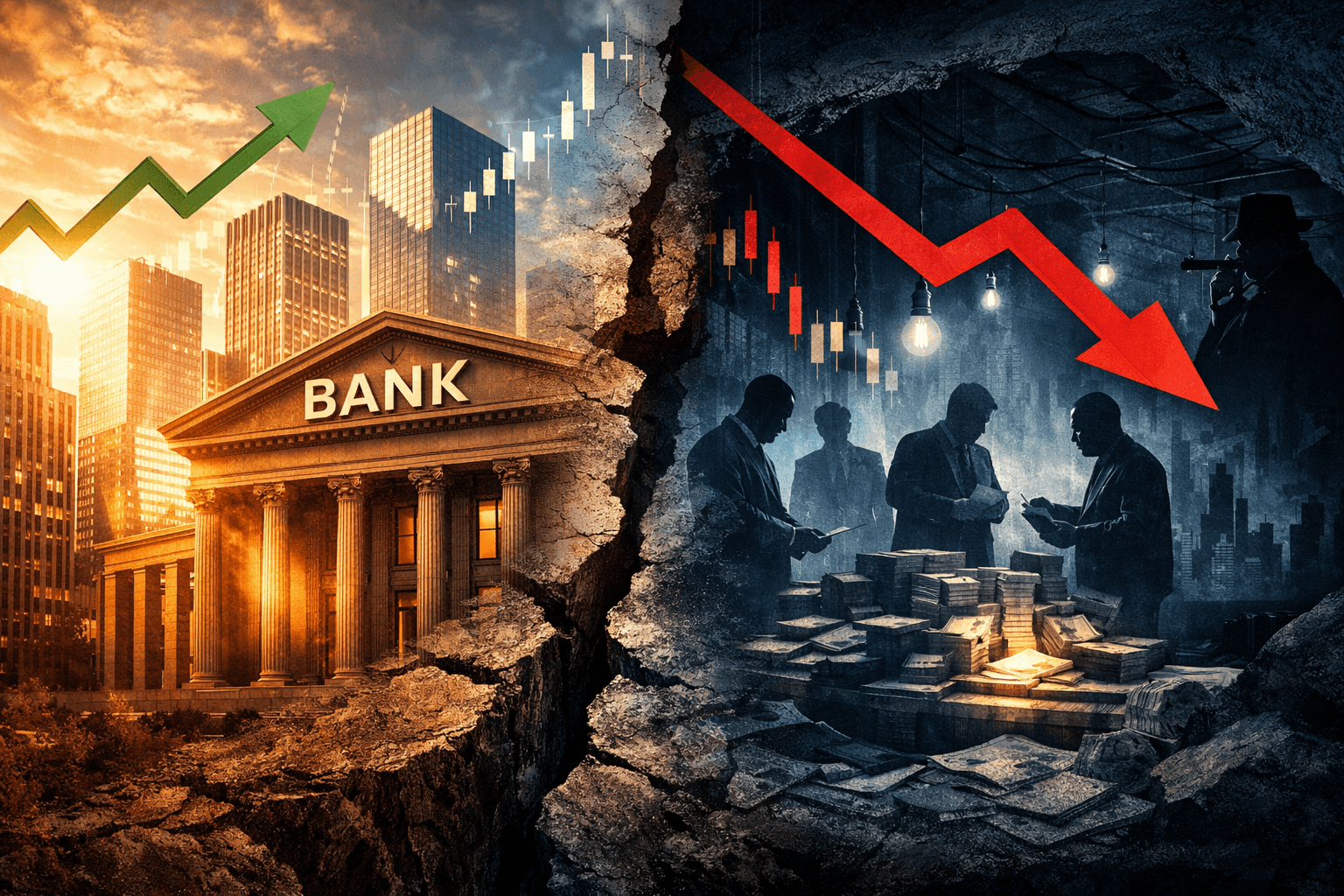
Wall Street did not kill credit risk after 2008. It may have just pushed it into a darker corner of the market.
The post-2008 banking story was supposed to be about safety. Banks were meant to deleverage, clean up balance sheets, and reduce the kind of risks that nearly detonated the financial system in the Global Financial Crisis. But the latest warning is more unsettling: a large share of that risk may not have disappeared at all. It may have simply migrated into the shadow-lending world of private credit, nonbank finance, and opaque funding chains.
That is the core argument behind the latest market anxiety. Banks have moved the equivalent of roughly 18 million BTC into shadow lenders, pointing to around $1.3 trillion in bank lending tied to nondepository financial institutions. Federal Reserve data show loans to nondepository financial institutions have indeed climbed to around $1.9 trillion in early 2026, while Fed research published in 2025 also highlighted how commitments to other nonbank financial institutions had surged to about $2.2 trillion after years of rapid growth.
That does not automatically mean another 2008-style collapse is imminent. But it does suggest the fault line may have moved. Instead of risk sitting squarely on bank balance sheets, more of it now runs through private credit funds, securitization vehicles, and other nonbanks that are typically less transparent and less tightly regulated than traditional lenders. The IMF and other stability watchers have repeatedly warned that the rapid growth of nonbank finance is creating new vulnerabilities for the global financial system.
The timing matters. Private credit has grown into a roughly $2 trillion market, and concerns around that sector have become harder to ignore in recent weeks. Reuters reported that investors have questioned valuations in Blue Owl’s private credit portfolio, while fund withdrawal limits and markdowns elsewhere have added to the feeling that the sector has not yet been tested by a full credit cycle. MarketWatch also reported that major banks now carry sizable private-credit exposure, and UBS has warned that the space still has not faced a true stress event.
This is why the “shadow lender” issue matters beyond finance insiders. When lending migrates from regulated banks to less visible credit channels, the system can look safer on the surface while becoming harder to map underneath. The New York Fed has argued that banks and nonbanks are not clean substitutes but deeply interconnected, with nonbanks often relying heavily on bank funding, credit lines, and back-end support. That means stress in private credit may not stay neatly contained inside private credit.


-640x427.png&w=3840&q=75)
-640x427.png&w=3840&q=75)
-300x200.png&w=3840&q=75)

-300x200.png&w=3840&q=75)